Roundtable: Politics of Humanitarian Aid in Syria
On September 30, the Syrian Peace Action Centre (SPACE), the Norwegian Centre for Humanitarian Studies (NCHS) and Peace Research Institute Oslo (PRIO) will host a roundtable discussion on the Politics of Humanitarian Aid in Syria. This event is for invited guests.
Background
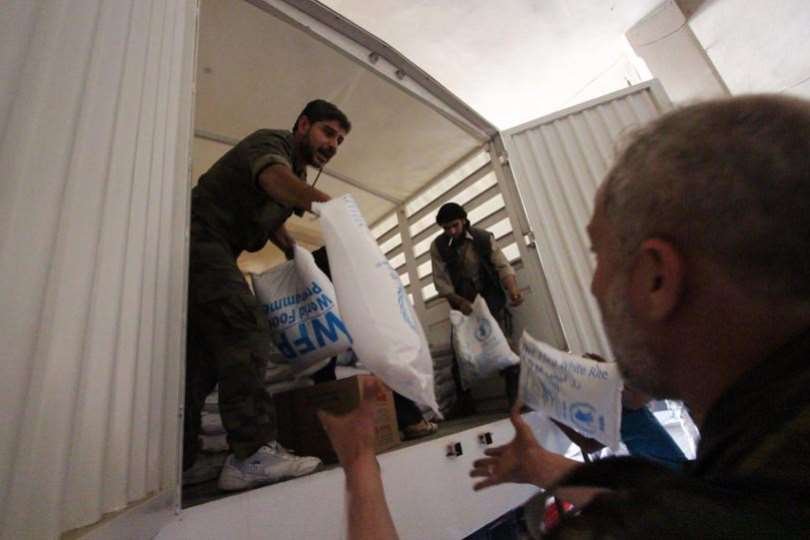
Delivering humanitarian aid in conflict situations has always been difficult. Syria is proving to be no exception. This panel aims to examine the contesting reality of politics and humanitarian principles with regards to aid distribution in Syria.
Despite their remarkable resilience and determination, Syrian aid workers are often criticized by international actors for lack of compliance with humanitarian principles — specifically for mixing politics with humanitarian work. Additionally, Syrian aid organizations are perceived to be lacking the institutional capacity, skills and operational standards to respond to such complex humanitarian emergencies. Against the changing battle lines and shifting alliances on the ground and between external powers, UN agencies and international NGOs are faced with a difficult task as they start to establish and expand their partnership with local actors operating in areas where international staff has no access.
Conversely, Syrian civil society groups have repeatedly expressed skepticism and mistrust towards some international aid organizations, especially the UN agencies, for the way they are implementing humanitarian principles. This criticism has materialized into a report published by the advocacy group The Syrian Campaign in June 2016, as well as a comprehensive investigation by The Guardian published in August 2016. The report accuses the UN of jeopardizing their impartiality, neutrality and independence by working closely with the Syrian government and concentrating their largest humanitarian efforts in the government-controlled areas.
Notwithstanding the Syrian cross-border response’s heavy dependence on local aid groups, Syrians deplore being used as subcontractors rather than equal partners, bearing an unfair share of risks and lacking contextualized and flexible funding approaches adopted by donors.
In the conflicting perceptions about the possibilities and limits of humanitarian aid, local Syrian discourse remains disconnected from its international counterparts. Such a disconnect has a negative impact on the civilian population and fosters mutual distrust among key humanitarian actors. This has culminated in 73 Syrian aid groups announcing the suspension of cooperation with the UN on 8 September, 2016.
Norway has been at the forefront to both provide and politically coordinate humanitarian assistance for Syria. Moreover, its principled and trust-based approach enables the Norwegian donor community to mediate between actors representing the different sides of the debate, and to leverage accountability of all relevant stakeholders.
The roundtable panel will try to address these questions:
- How is it possible to maintain a neutral and impartial space for humanitarian aid in Syria?
- How do politics influence the priorities of the largest UN assistance operation in decades? Whose responsibility is it to enforce and adhere to the humanitarian principles?
- What role can Norwegian donors and organizations play to restore the trust between Syrian aid organizations and UN agencies?
- How can Norwegian donors and organizations strike the balance between strengthening and institutionalizing their Syrian local partners to fulfil their (often politically-loaded) vision, while ensuring adherence to international humanitarian standards?
Programme
Presentation: Bissan Fakih (The Syria Campaign)
Presentation: Reinoud Leenders (King’s College London)
Presentation: Marcell Shehwaro (Kesh Malek)
Comments: Kathrine Raadim (Norwegian People’s Aid)
Comments: MFA representative (tba)
Chair: Marte Heian-Engdal (PRIO)